

#53 Money For Nothing
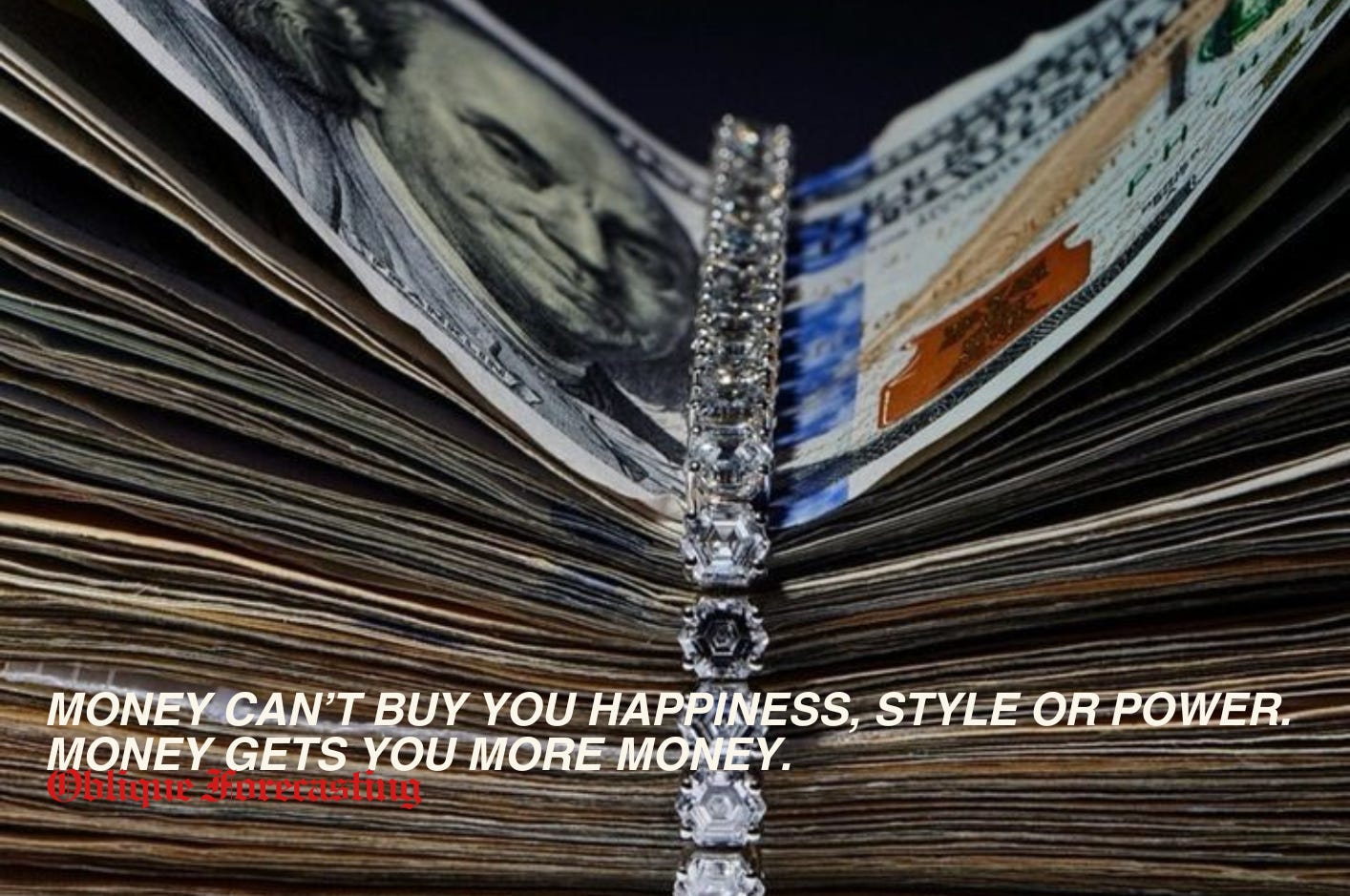
Money's the new sex.


Hiiii. No intro today. I hope you’re coping with the hellscape that constitutes the current news cycle. xoxo Esther 💋
🤑 I’m bullish on openly greedy businesses.
Wealth fascinates. Always have, always will.
A rags-to-riches story—Cinderella, rags-to-riches-to-rags-again arc—The Great Gatsby, and a retribution story—Robin Hood— always stir something in us. As kids, they had us believing in meritocracy. Or at least good luck.
Looking at more recent examples in pop culture has me wondering about the chicken-and-egg conundrum. What came first: the era-defining piece of entertainment, or did the period’s collective relationship to money dictate the stories we told about it?
For Gen X kids, the answer once felt obvious. The rich guy was usually the villain: entitled, cruel, morally hollow. See: Trading Places (1983), Less Than Zero (1985), They Live (1988). For them, money didn’t need to be redistributed to be suspect. It was already guilty by association.
By the time millennials came of age, the moral frame shifted. Money itself was no longer the end goal; power was. The founder, the girlboss, the disruptor, replaced the villain. Wealth was tolerated and even admired!! as long as it was framed as a by-product of ambition, creativity, or “changing the world.” Capital needed a mission statement.
Then something else happened.
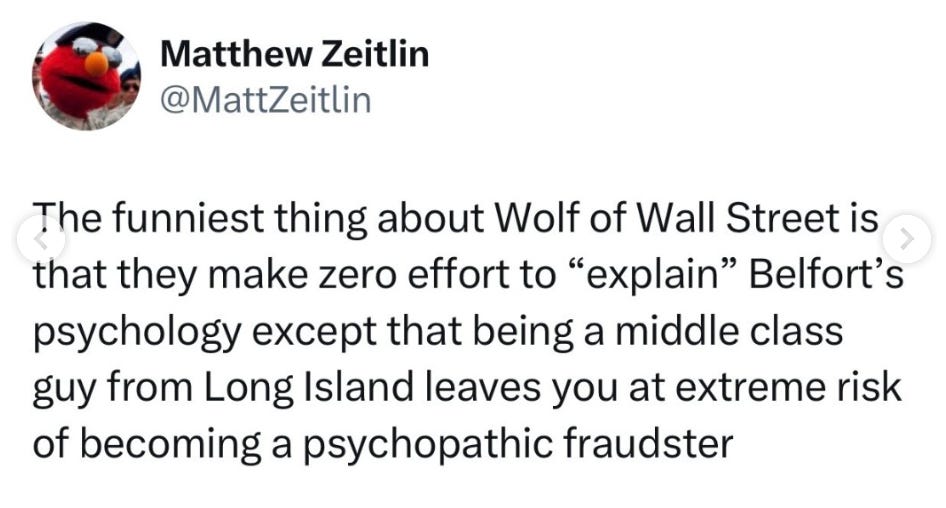
Films that were meant as cautionary tales, such as Wall Street (1987), American Psycho (2000)(I always need to add this caveat: the book was written by a ¡gay man! and the film directed by a ¡woman! and both are meant to read as satire yet so many take it as face value), and The Wolf of Wall Street (2013), stopped functioning as warnings and started operating as templates. Finance bros (and, more broadly, straight men with Bloomberg tabs open) didn’t absorb the critique; they absorbed the aesthetic. A pile of cash, stripped of context, consequence, or ethics, became enough. The moral collapsed into the visual.
We may have experienced a short-lived revival last year with the emergence of Boom Boom. Money, or at least money cosplay, was a way to buy into status symbols:

-
Fast-forward to now, and the obsession has intensified—and flattened. In über-successful series like Succession and Industry, money no longer needs power, legacy, or even victory as a justification. It circulates for its own sake. There is no higher purpose. Only scale. No vision. Only leverage. Hoarding is no longer coded as amoral; it’s coded as competence.
This cultural shift matters because it’s leaking out of fiction. Investing is going mainstream. Not as a means to build something, but as a form of identity, entertainment, even belonging.
-
Creators and celebrities are no longer celebrated for building things but for allocating capital. The founder gives way to the investor. Creation is optional; proximity to money is enough. Owning the table matters more than making the meal:

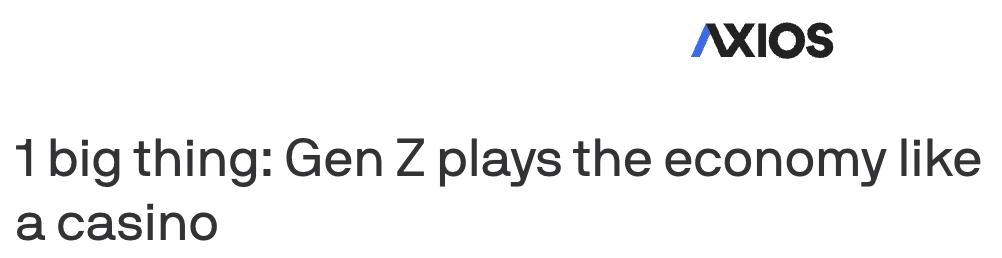
There’s a boom in popularity for various ways to make money fast.
Online betting is skyrocketing and it’s not just about sports anymore, with platforms like Kalshi and Polymarket allowing consumers to place bets on everything from current events to weather patterns.
Retail investing is soaring as young people see the stock market as another form of income, a bet that has paid off for them amid the AI-driven rally.
Influencer is now the top profession that Gen Z says it aspires to, with over half of Gen Z and millennials in a survey saying they would choose a social media career over any other profession, per Morning Consult.
Billionaire creators like MrBeast is also inspiring younger generations to try to build massive wealth by building big followings on social media.
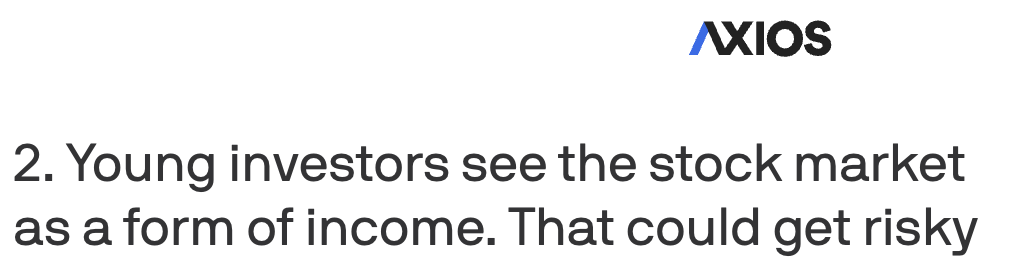
Prediction markets, financial gamification, and speculative behaviour aren’t edge phenomena anymore: they’re becoming cultural infrastructure. Money is increasingly treated less like capital and more like chips.
Could I even go out on a limb and say there’s a correlation between all the articles proclaiming that younger generations don’t date/don’t have sex/don’t party anymore and the rise in interest in money for the sake of money itself… Well.
Where this leaves us:
Financialisation is absorbing leisure, identity, and desire.
Betting replaces partying. Investing replaces ambition. Speculation replaces belief. When futures feel constrained, wagering becomes a form of agency.
Investing is going mainstream, but not democratising.
Platforms multiply, access expands, language softens (“community,” “participation,” “financial literacy”), yet upside remains asymmetrical. Small investors provide liquidity, data, and narrative heat; scale captures the gains.I’m bullish on businesses that reward greed openly.
Prediction markets, financial betting platforms, perpetual trading, zero-friction speculation. They work precisely because they remove moral pretense. No mission statement, no founder myth. Just good old exposure to upside and the thrill of being right.
This isn’t a moral judgment. It’s a forecast. The call is coming from inside the house! I translate cultural shifts into investment theses via Oblique Forecasting. I work in investing-adjacent media. I benefit from the same dynamics I’m describing.
If you’ve made it this far, consider adding a like, a comment or sharing the post.

📈 Bullish news
AI-Powered Creator Monetisation Platform, Fanvue, Hits $100M Run Rate and Raises $22M Series A Investment - as Leading Global Creators Rush to Join the Platform (yahoo! finance). Fanvue isn’t just another subscription platform; it’s betting that AI will redefine how creators monetise. Over 93% of its 250K creators already use its proprietary AI tools: analytics, voice cloning (via ElevenLabs), AI-generated content, and even AI agents handling DMs with fans. With 17 million monthly active users and 450% YoY revenue growth, the platform was just named Fastest Growing Company in Europe at the Stevies.
Sequoia to invest in Anthropic, breaking VC taboo on backing rivals. Venture capital firms have historically avoided backing competing companies in the same sector, preferring to place their bets on a single winner. Yet here’s Sequoia, already invested in both OpenAI and Elon Musk’s xAI, now throwing its weight behind Anthropic, too. (TechCrunch)
2026 May Be the Year of the Mega I.P.O. If SpaceX, OpenAI and Anthropic go public, they will unleash gushers of cash for Silicon Valley and Wall Street. (NYT)
I had written about Phia last year, Phoebe Gates and Sophia Kianni’s Phia raises $35M to ‘make shopping fun again’ (TechCrunch)
In 2026, We Are Friction-Maxxing (The Cut). You read it in Oblique Forecasting first:
Known uses voice AI to help you go on more in-person dates. The founders created a voice-powered AI onboarding system for their app that helped them learn more about users without them having to fill out a form. What they discovered: People loved to talk, and that increased the length of the onboarding session, with the app clocking 26’ on average. The startup has raised $9.7 million from investors. (TechCrunch) Well well well, if that’s not the Gen Z founders I was summoning to create an interesting new dating app:
Recommended read of the week if you liked the above newsletter and share the doubts I have re: dating apps:


📉 Bearish news
Americans Are the Ones Paying for Tariffs, Study Finds. Research contradicts President Trump’s claim that foreigners are footing the bill, and could weaken his hand in the dispute over Greenland (WSJ)
An alternative to dating apps: Locked in and celibate. Young tech founders are going “monk mode,” swearing off dating to focus entirely on building their startups. “Every night you spent out is time you could have spent building your startup...Most founders wait until the startup is more stable, like Series B.”(BI)
Very true about American Psycho. I watched it a few years ago and couldn’t understand why it became such a symbol for “deep work and build in silence” type videos on YouTube.
I mean, the guy is a serial killer… so maybe that’s why.
"Creators and celebrities are no longer celebrated for building things but for allocating capital." Like the Sidemen starting a VC firm for example: https://www.uktech.news/news/investment-news/british-youtube-group-sidemen-launch-new-vc-firm-20250519